

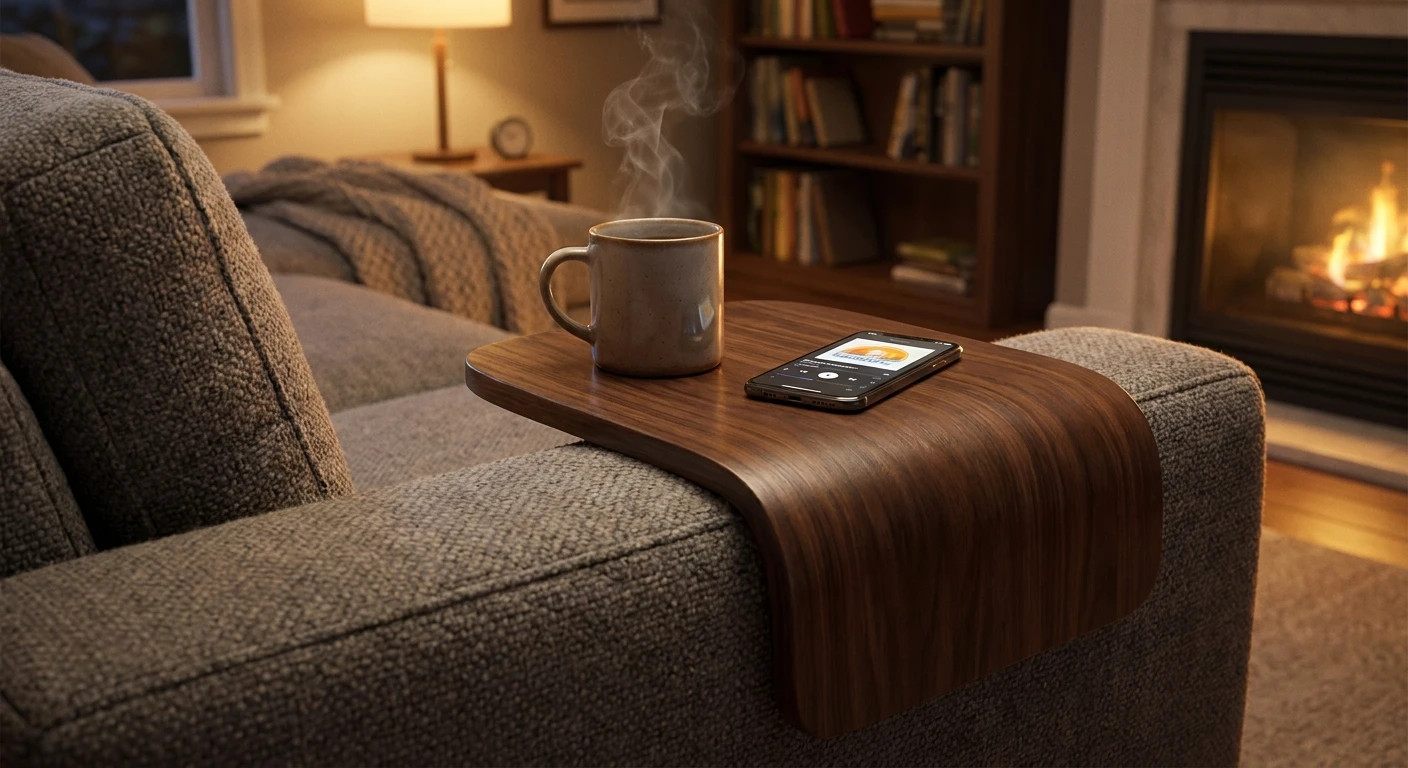
Why You Need a Couch Arm Table Right Now
Finding the perfect spot for your coffee shouldn’t be a balancing act, which is exactly why a couch arm table changes the entire living room dynamic. We all recognize that quiet anxiety of resting a full, steaming mug on a soft, unpredictable sofa cushion. It is a disaster waiting to happen. You lean back, the cushion shifts, and suddenly you are spending your weekend scrubbing stains out of expensive upholstery. A dedicated resting surface right on the armrest bridges the gap between total relaxation and practical utility, eliminating the need to constantly lean forward toward a distant coffee table.
By securing a flat, stable platform directly onto your sofa, you optimize your immediate seating area for modern multitasking. Whether you are typing on a smartphone, snacking, or managing three different remote controls, having an immediate, sturdy surface keeps everything within an arm’s reach. This simple piece of furniture geometry maximizes convenience without eating up valuable floor space. The thesis here is straightforward: integrating an armrest tray into your seating arrangement fundamentally upgrades your domestic comfort, providing an immediate, structural solution to everyday living room clutter.
Read also: Guide to Finding the Best Dishwasher Tablets; Understanding a Local Gun Buy Back Today.
Maximizing Your Sofa’s Functionality
Understanding the immediate benefits of this accessory requires looking at how we actually interact with our living spaces. The core value proposition lies in space efficiency and spill prevention. For example, in a tight apartment where a traditional coffee table blocks the walkway, an armrest tray provides all the utility with zero footprint. Similarly, for a busy household with kids or pets, having a secure, elevated station for drinks prevents catastrophic spills that normally occur when cups are left on the floor or precariously perched on soft fabric.
You have a lot of material choices, and each impacts the aesthetic and functional lifespan of your living area. Here is a quick breakdown of what you can expect from different materials:
| Material Type | Durability & Wear | Design Aesthetic |
|---|---|---|
| Solid Hardwood | Highly scratch-resistant, long lifespan | Classic, warm, premium look |
| Flexible Bamboo | Good moisture resistance, eco-friendly | Modern, minimalist, organic |
| Silicone & Metal | Waterproof, completely shatterproof | Industrial, highly functional, sleek |
To make sure you get the absolute best fit for your furniture, you have to follow a structured selection process. Grabbing the first one you see often leads to a mismatched, wobbly setup.
- Measure the exact width of your sofa arm: Not all arms are created equal. Measure across the flattest top part to ensure the tray’s central base will sit perfectly flush without rocking.
- Evaluate the gripping mechanism: Look closely at how the sides articulate. Spring-loaded hinges grab the sides aggressively, while weighted fabric sides rely on gravity and friction.
- Match your daily habits: If you drink a lot of hot tea, ensure the surface has a heat-resistant coating. If you work from the sofa, look for models with built-in device slots to hold a tablet or phone upright.
The Origins of Furniture Accessories
The concept of keeping items close at hand while seated is certainly not new. If you look back at Victorian parlor designs, you see the earliest iterations of side tables explicitly designed to hover near the arms of heavy, tufted armchairs. However, these were entirely separate pieces of furniture, often bulky and difficult to maneuver. They served the same purpose—holding tea, reading spectacles, and small books—but lacked the direct integration that modern accessories provide. The physical separation between the chair and the table meant you still had to awkwardly reach over the side.
The Evolution of Space-Saving Design
As housing trends moved through the mid-20th century, living spaces became slightly more compact, and the heavy parlor furniture gave way to mid-century modern aesthetics. Furniture designers began experimenting with built-in utility. Sofas were sometimes crafted with wooden panels integrated right into the upholstery. The desire for a seamless look pushed inventors to create removable trays that mimicked these built-in features without requiring you to buy a brand-new sofa. This era saw the first iterations of slatted, roll-up wooden mats that draped over the armrests, relying purely on their own weight to hold a reasonable shape.
The Modern State of Living Room Ergonomics
Today, the landscape of living room ergonomics is highly advanced. We are no longer just resting a cup of tea; we are balancing expensive smartphones, tablets, ergonomic mice, and complex snacks. The contemporary market demands multi-functional, precision-engineered solutions. Modern trays incorporate advanced non-slip polymers, precisely routed grooves for device cables, and adjustable tension hinges that can snap onto a thin modern sofa arm just as easily as they drape over an overstuffed, rounded one. The evolution from a simple wooden block to a highly engineered accessory reflects our changing domestic habits.
The Physics of Stability and Grip
Securing a rigid flat surface to a soft, rounded, yielding fabric relies entirely on basic physics. High-quality trays use the principle of the coefficient of friction. By lining the underside of the wooden or plastic slats with specialized elastomers or textured velvet, the design maximizes the grip on the microscopic fibers of your couch. Furthermore, spring-loaded models use a calculated clamping force. The tension springs push the side flaps inward against the vertical drop of the armrest, creating a counter-force that prevents lateral sliding. Gravity does the rest, pulling the main platform down directly onto the apex of the curve.
Material Science in Everyday Furniture
The materials chosen for these platforms undergo specific treatments to survive the harsh environment of a living room. A tray will face condensation from ice water, the intense localized heat of a coffee mug, and the abrasive impact of dropping a heavy remote. Manufacturers rely on cross-laminated wood or heavily treated bamboo to prevent warping. Wood naturally expands and contracts with moisture, so without the correct chemical sealants, a flat tray would quickly bow and become dangerously unstable.
- Bamboo’s tensile strength: Bamboo is technically a grass, and its continuous vascular bundles give it a higher strength-to-weight ratio than many hardwoods, making it ideal for thin, lightweight slatted designs.
- Polyurethane coatings: Modern trays are finished with advanced polyurethane that seals the porous wood surface, preventing water from seeping in and causing internal rot or mold.
- Elastomer backing: The rubberized backing found on premium models uses thermoset silicones that maintain their grip and flexibility across massive temperature ranges without degrading or melting into your fabric.
Step 1: Measuring Your Armrest Accurately
Before buying anything, take a flexible tape measure and run it across the exact top of your sofa arm. You need to identify the “flat zone.” If your sofa arm is perfectly square, measure edge to edge. If it is heavily rounded, find the apex and measure the immediate three inches on either side. This tells you the minimum width the center solid platform of your tray needs to be to avoid rocking like a seesaw.
Step 2: Selecting the Core Material
Match the material to your household’s chaos level. If you have a quiet household, natural untreated wood looks phenomenal. If you have toddlers running around with juice boxes, you absolutely need a bamboo or silicone model treated with a heavy-duty waterproof seal. Liquids will spill, and you want a surface that wipes clean with a simple paper towel without leaving a permanent water ring.
Step 3: Positioning for Maximum Stability
When you place the tray on the sofa, do not just drop it. Press down firmly on the center plate to compress the couch foam slightly, then wrap the side slats firmly against the vertical sides of the arm. This seats the tray into the fabric, maximizing the surface contact area and engaging the non-slip backing.
Step 4: Testing the Weight Capacity
Never test a new tray with a full cup of hot coffee. Start with a heavy, closed book. Place it in the center, then lightly bump the side of the sofa with your hip. Observe how the tray reacts. If it shifts significantly, you either have it positioned incorrectly, or the tray is too wide for your specific sofa design.
Step 5: Routine Cleaning and Maintenance
Dust and fabric fibers will naturally collect on the non-slip backing over time, drastically reducing its grip. Once a month, wipe the underside of the tray with a slightly damp microfiber cloth to remove this debris. This restores the coefficient of friction and keeps the tray locked firmly in place.
Step 6: Adapting for Different Beverages
If you switch between stemware, heavy mugs, and tall water bottles, utilize the accessories. Some trays come with modular inserts. Use deep cup holder inserts for tall glasses to prevent tipping, and keep the flat surface clear for wider, bottom-heavy mugs.
Step 7: Seasonal Wood Conditioning
If you purchased a raw or oiled wood tray, the dry winter air from your home’s heating system will dry it out. Apply a food-safe mineral oil or beeswax polish twice a year. This keeps the wood from cracking and maintains that rich, vibrant finish that makes the accessory look like a premium piece of furniture.
Myths vs. Reality of Sofa Trays
Myth: They only fit perfectly square, structured sofa armrests.
Reality: While rigid C-tables need specific dimensions, slatted roll-up designs are engineered specifically to drape over heavily rounded, overstuffed armrests safely.
Myth: The constant friction will damage your sofa’s upholstery over time.
Reality: High-quality models feature soft felt or non-abrasive silicone backing that protects the fabric. Damage usually only occurs if you trap sharp crumbs under a heavy wooden tray.
Myth: You cannot put boiling hot items directly on them.
Reality: Most modern living room trays are finished with heat-resistant coatings designed exactly for hot coffee and soup bowls, though using a coaster adds an extra layer of protection.
Myth: They are purely meant for holding drinks.
Reality: The modern designs feature intricate router cuts for holding smartphones upright, recessed pockets for remotes, and large flat areas for standard-sized dinner plates.
Can I use one on a leather sofa?
Yes, absolutely. In fact, the non-slip silicone backings are incredibly effective on smooth leather, preventing the sliding that normally happens when placing items on slick materials.
Are they safe for heavy laptops?
Generally, no. While they can hold a lightweight tablet or e-reader in the built-in slot, placing a full-sized, heavy laptop on a flexible armrest tray introduces too much weight to the edges, risking a tip-over.
Do they slide around easily?
Not if you buy a quality model. Cheaper plastic versions might slide, but premium designs use gravity, tension springs, and rubberized backing to lock firmly onto the fabric.
How do I clean a bamboo tray?
Wipe it down with a damp cloth and mild dish soap. Do not submerge it in water or put it in the dishwasher, as soaking will compromise the glue holding the slats together.
Will it fit a reclining chair?
Yes, as long as the recliner’s armrest is stationary. If the armrest moves or tilts significantly when you recline, you should remove any drinks before leaning back.
Are there options with built-in cup holders?
Yes, many premium models feature recessed circles specifically designed to lock a standard mug or glass in place, offering an extra barrier against accidental bumps.
Can I fold it away when not in use?
The slatted varieties are fantastic for this. You can easily roll them up into a compact cylinder and tuck them into a drawer or a basket when you need the armrest clear.
Conclusion
Integrating a stable, reliable surface right where you sit elevates your daily routine from chaotic to comfortable. You stop worrying about spills, you always know exactly where your phone is, and your living room instantly looks more organized. Do not let another mug of coffee tumble onto your cushions. Measure your sofa arm today, find the material that perfectly matches your interior design, and upgrade your seating experience immediately.