

If you searched for “australian men’s cricket team vs england cricket team match scorecard,” chances are you were not hunting for just a row of numbers. You probably wanted the story hidden inside them. That’s fair. A good cricket scorecard is never only arithmetic. It’s pressure, drift, momentum, panic, stubbornness and, sometimes, a proper little plot twist wearing pads.
The most recent completed meeting between the old rivals was the fifth Ashes Test at the SCG in January 2026. Australia won by five wickets. On paper, that sounds tidy enough. In reality, it was anything but tidy. Australia piled up 567 in the first dig, looked miles ahead, then still had to squint through a tense chase of 160 as England found late life and made the hosts work harder than they probably expected.
That’s why this scorecard has lingered. It carried the whole feel of the series in miniature. Australia were stronger, deeper and calmer across the big passages. England had moments, some really good ones, but too often they were playing catch-up. By the end, the match finished 4-1 in Australia’s favour, and the scoreboard felt less like a one-off result and more like a final summary of the summer.
So here’s the useful part. Rather than dumping raw figures and walking away, let’s read the scorecard properly — the way fans actually do. What happened? Which numbers mattered most? Where did the game turn? And what did this match say about the wider state of both teams?
The scorecard first, because that’s why we’re here
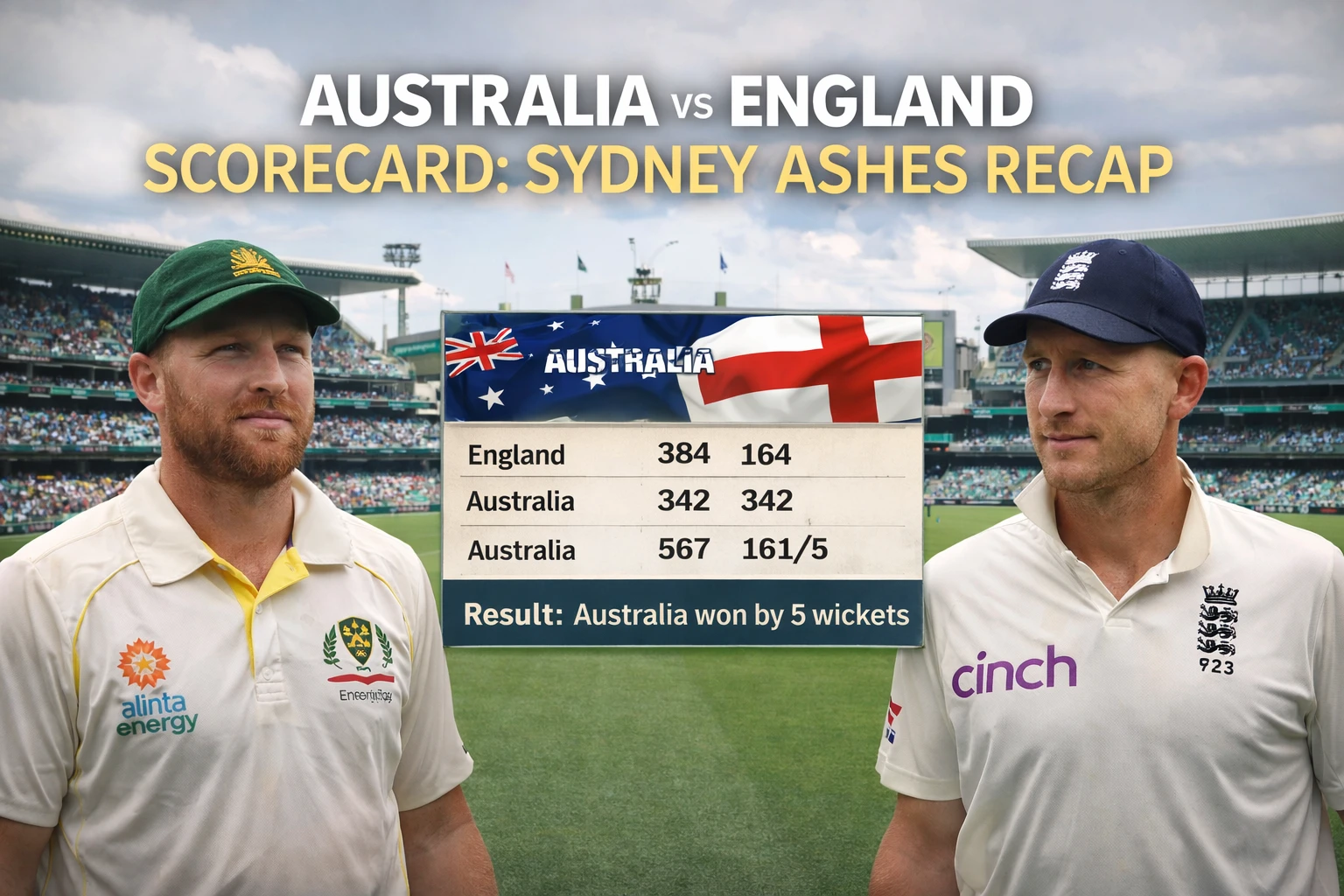
Let’s start with the clean version. Australia made 567 in their first innings. England replied with 384. England then added 342 in the second innings, setting Australia 160 to win. The hosts got there at 161 for 5.
That already tells a pretty sharp story. England were competitive in pieces, even admirable in parts, but they were always chasing a first-innings hole. Australia’s 567 was the heavyweight punch of the match. Everything that came later, even England’s spirited second effort, was shaped by that one huge reply.
| Innings | Team | Score | What it meant |
|---|---|---|---|
| 1st innings | England | 384 | A solid total, driven by Joe Root, but not big enough to fully own the game |
| 1st innings | Australia | 567 | The defining innings of the Test and the reason Australia controlled the match |
| 2nd innings | England | 342 | A strong fightback that made the finish awkward and tense |
| 2nd innings | Australia | 161/5 | Enough to win, though not as smoothly as the hosts would have liked |
Simple enough, right? But the real texture sits inside those totals.
England’s first innings was good — just not good enough
England’s 384 was not a collapse. Let’s be fair about that. On another day, on another surface, it might even have been the platform for a match-winning push. Joe Root’s 160 was the backbone of it, and Harry Brook’s 84 gave the innings shape and urgency. It had class. It had some authority. It had the look of a side finally giving itself a proper chance.
But there was a catch, and it was a big one. Once you make 384 in Australia, especially at the SCG, you still want the scoreboard to feel heavier than that. You want 450-plus. You want the hosts under real pressure. England did not quite get there.
That’s the annoying thing about cricket. A total can be both good and slightly disappointing at the same time. This was one of those totals.
Michael Neser’s 4 for 60 mattered too. It stopped England from stretching the innings into something truly commanding. Instead of England owning the Test, they were merely in it. That sounds like a tiny distinction. It wasn’t. It shaped everything.
- Joe Root gave England class and control.
- Harry Brook supplied tempo.
- But England did not cash in hard enough once the platform was there.
That pattern felt familiar through the series, to be honest. Enough promise to stay visible. Not quite enough ruthlessness to take the match by the throat.
Then Australia batted, and the whole match bent around it
This was the moment the Test really took its final shape. Australia’s 567 was not only large. It was authoritative. It pushed England out of comfort and into survival mode.
Travis Head made 163, and that innings summed up a lot about his summer. It was fast, decisive and properly annoying if you were on the England side. He has that knack of making bowlers feel like the field is half a beat behind him. Then Steve Smith added 138, which was a very Smith way of doing damage — measured, relentless, a bit clinical, and somehow even more irritating because he rarely looks like he’s taking wild risks.
Together, those innings did two things at once. They inflated the total, obviously. But they also squeezed the emotional air out of England’s position. Suddenly 384 looked thin. Suddenly every English over felt like maintenance rather than attack. Suddenly the match belonged to Australia.
And that is one reason scorecards matter more than people think. They show the shape of authority. Australia were not only ahead on runs. They were dictating the match.
The lower-order support helped as well. This was not one of those innings where a side leaned on two players and then tripped over itself. Australia had enough contributions around the main acts to keep England in the dirt for longer than the tourists could really afford.
| Key performer | Innings | Score or figures | Why it mattered |
|---|---|---|---|
| Joe Root | England 1st innings | 160 | Held the first innings together and gave England a respectable total |
| Harry Brook | England 1st innings | 84 | Added pace and support when England needed momentum |
| Michael Neser | Australia bowling | 4/60 | Stopped England from stretching their first innings into a giant score |
| Travis Head | Australia 1st innings | 163 | Turned the match hard in Australia’s favour and set up the result |
| Steve Smith | Australia 1st innings | 138 | Added heavy scoreboard pressure and punished England’s drift |
| Jacob Bethell | England 2nd innings | 154 | Dragged England back into the Test and made the chase feel real |
| Josh Tongue | England bowling, Australia 2nd innings | 3/42 | Gave England hope by making Australia wobble in the chase |
| Alex Carey and Cameron Green | Australia 2nd innings | 16* and 22* | Finished the job when the game briefly started to feel twitchy |
England’s second innings had real fight in it
Now, this is where the scorecard gets more interesting. England could have folded. Plenty of touring sides would have. Instead, they made 342 and forced Australia to pay attention again.
Jacob Bethell’s 154 was the headline act here, and fair enough too. It was bold, it was skilful and it had exactly the kind of edge England needed. Not enough to flip the result outright, but enough to drag the game back into the light.
That innings mattered for a couple of reasons. First, it gave England a target to defend. Not a big one, sure, but at least a living one. Second, it offered a glimpse of where the side might look next. When a young player makes that kind of score under series pressure, people notice. Coaches notice. Selectors notice. Opponents definitely notice.
England’s 342 did not erase the damage of the first-innings deficit, but it changed the emotional tone of the last day. Instead of a dull procession, the SCG got a live chase with nerves in it.
And honestly, that made the scorecard better. A match that is too neat can be forgettable. This one had a wobble. Sport fans remember wobble.
- Bethell gave England belief when the match looked gone.
- The total of 342 was enough to make Australia work.
- It turned a comfortable-looking finish into one with at least a little sweat in it.
The chase of 160 was supposed to be simple. It wasn’t.
This is the bit that makes the scorecard feel more dramatic than the result line suggests. Chasing 160 after scoring 567 in the first innings should have been a routine lap to the tape. It was not routine.
Australia got home at 161 for 5, which tells you straight away that England at least managed to shake the room. Josh Tongue took 3 for 42 and created a few of those “hang on a sec” moments every chasing side hates. Travis Head made 29. Jake Weatherald made 34. Marnus Labuschagne chipped in 37. Steve Smith made 12. Usman Khawaja, in his final Test, made just 6.
That run list is revealing. It is full of starts, not finishes. Nobody really nailed the chase in one clean hand. Instead, Australia staggered, paused, and then let Alex Carey and Cameron Green do the calming work at the end.
That’s useful context when reading the raw score. A score of 161 for 5 can look merely functional. In reality, it felt more jagged than that. England made Australia blink. Not for long, but long enough to remind everyone that even small fourth-innings targets have teeth when wickets fall in clumps.
There is also a little wider point here. Good teams do not only dominate when they are flying. They also finish when they are scruffy. Australia did that. It was not graceful. It was enough.
What the match said about Australia
By the time this Test ended, Australia had already retained the Ashes. But the way they finished the job still said something useful about the side.
First, they had more batting weight across the series. Not just top-order stability, but proper middle-order force. Travis Head’s run-making was the standout example. Steve Smith still had the ability to seize a match. Alex Carey kept popping up at important moments. And even when the final chase got a bit messy, there was still enough calm left in the line-up to close the thing out.
Second, they looked more comfortable living inside the long game. England had bursts. Australia had shape. That is often the difference in Test cricket. One team can win sessions. The other wins the match by owning the slower passages in between.
Third, the 4-1 series result felt earned rather than inflated. Sometimes a scoreline lies a little. This one didn’t really. England were competitive in patches, yes, but Australia were stronger for longer.
And that is exactly what this scorecard reflects. Not a freak escape. Not a lucky nick. A superior side taking the final step, even with a wobble on the way.
- Australia’s first-innings batting remained the clearest point of difference.
- The side had enough composure to absorb a late squeeze.
- The 4-1 result looked like the right reading of the summer, not a flattering one.
What the match said about England
England’s side leaves a more complicated picture, which is probably why the scorecard is still interesting from their angle too.
There were clear positives. Joe Root looked like Joe Root again, which is not a small detail. Harry Brook still had scoring intent. Jacob Bethell’s second-innings 154 was the kind of innings that makes people sit up. Josh Tongue’s 3 for 42 in the chase gave England a burst of real life.
But then comes the harder part. England kept producing pockets of quality without owning enough of the match around them. That is a frustrating pattern, because it makes the team look closer than the result says while still leaving them beaten.
Take this Sydney Test. England had the best individual first-innings score in the match. They had the best second-innings resistance from either side. They made Australia nervous in the chase. And still they lost. Why? Because the one huge Australian innings in the middle of the game outweighed everything else.
That is not just bad luck. That is a structural issue. It speaks to pressure, bowling discipline, control through long spells and the inability to stop one innings from getting completely away.
So yes, England showed fight. The scorecard proves that. But it also shows why fight alone was not enough.
Why people still search for the scorecard
There’s a reason search terms like this stay alive after the match is over. Fans go back to scorecards for three main reasons. First, to check the plain facts — who made what, who took wickets, what the target was. Second, to settle arguments. Third, to relive the shape of the game.
This match suits all three.
If you are an Australian fan, the scorecard is a neat final stamp on a winning Ashes campaign. If you are an England fan, it is one of those maddening documents that shows your team had enough moments to stay interesting without ever quite taking control. And if you are neutral, it is just a good, rich Test scorecard — the kind that tells a full story in numbers.
That’s the beauty of cricket records, really. A football score can end up looking thin once the emotion fades. A proper Test scorecard ages better. It keeps the shape of the struggle.
FAQ
What was the latest men’s Australia vs England match?
The latest completed men’s match between Australia and England was the fifth Ashes Test at the Sydney Cricket Ground in January 2026.
Who won the match?
Australia won by five wickets.
What were the full innings scores?
England made 384 and 342. Australia made 567 and then 161 for 5 in the chase.
Who was Player of the Match?
Travis Head, mainly for his first-innings 163, which shaped the whole result.
What was the target in the fourth innings?
Australia needed 160 to win and reached 161 for 5.
Who were the standout England batters?
Joe Root with 160 in the first innings and Jacob Bethell with 154 in the second were the biggest English contributions.
What did the result mean for the Ashes series?
It gave Australia a 4-1 series win in the 2025/26 Ashes.
Conclusion
The latest Australia vs England men’s cricket scorecard was more than a final scoreline. It was a compact version of the whole Ashes story. England had class, resistance and the occasional punch back. Australia had the bigger innings, the calmer finish and, over time, the firmer grip on the series.
That’s why the Sydney scorecard still works as a read on its own. Joe Root’s 160 gave England hope. Travis Head’s 163 bent the match Australia’s way. Jacob Bethell’s 154 gave the final day a pulse. Josh Tongue’s burst in the chase made the hosts sweat. Then Alex Carey and Cameron Green shut the door.
And maybe that’s the cleanest way to put it. England made the ending interesting. Australia owned the match that mattered most. The scorecard says exactly that, even before anyone writes a word around it.