
Book lists are funny things. People roll their eyes at them, argue with them, screenshot them, send them into group chats, and then — let’s be honest — quietly save them for later. That’s part of the charm. A good list is never just a list. It’s a mood board, a confession, a reading diary, a tiny culture war and a shopping guide all at once.
There’s a difference, and readers know it.
More than a ranking, really
The first thing worth saying is simple: the ABC Top 100 Books was built as a public vote, not a critic-only exercise. That changes the tone straight away. When thousands of readers get involved, the final list stops being a narrow cultural signal and starts feeling like a wider reading map. It tells you less about prestige alone and more about affection, memory, re-read value, recommendation power and plain old impact.
That matters because the books people admire and the books they carry around in their heads are not always the same. Some novels win awards, get reviewed beautifully and then drift out of everyday conversation. Others burrow in. They get passed from friend to friend, pressed into birthday hands, discussed at dinner, quoted badly, remembered for years. Those are different forms of success.
The ABC format made room for that second kind of success. And you can see it in the results. The top end of the list was full of books that people do not just respect. They love them. They revisit them. They talk about them like people talk about a suburb they grew up in or a song they heard at exactly the right time.
That’s not soft evidence. In culture, that is the evidence.
What the top 10 quietly says
Look at the top 10 and a pattern starts to show. These are books with narrative pull. Books with strong emotional weather. Books that give readers a world to enter and people to live alongside for a while. Even when the writing is elegant or ambitious, the stories still move. They don’t just sit there looking clever.
That tells us something useful about Australian reading taste. Readers here do not seem to be chasing difficulty for its own sake. They want books that feel alive. Books with momentum. Books that have enough craft to satisfy serious readers, but enough heart to reach beyond the literary bubble.
That’s one reason the result felt broadly right, even to people who wanted a different winner.
| Rank | Book | Author | Why it fits the public mood |
|---|---|---|---|
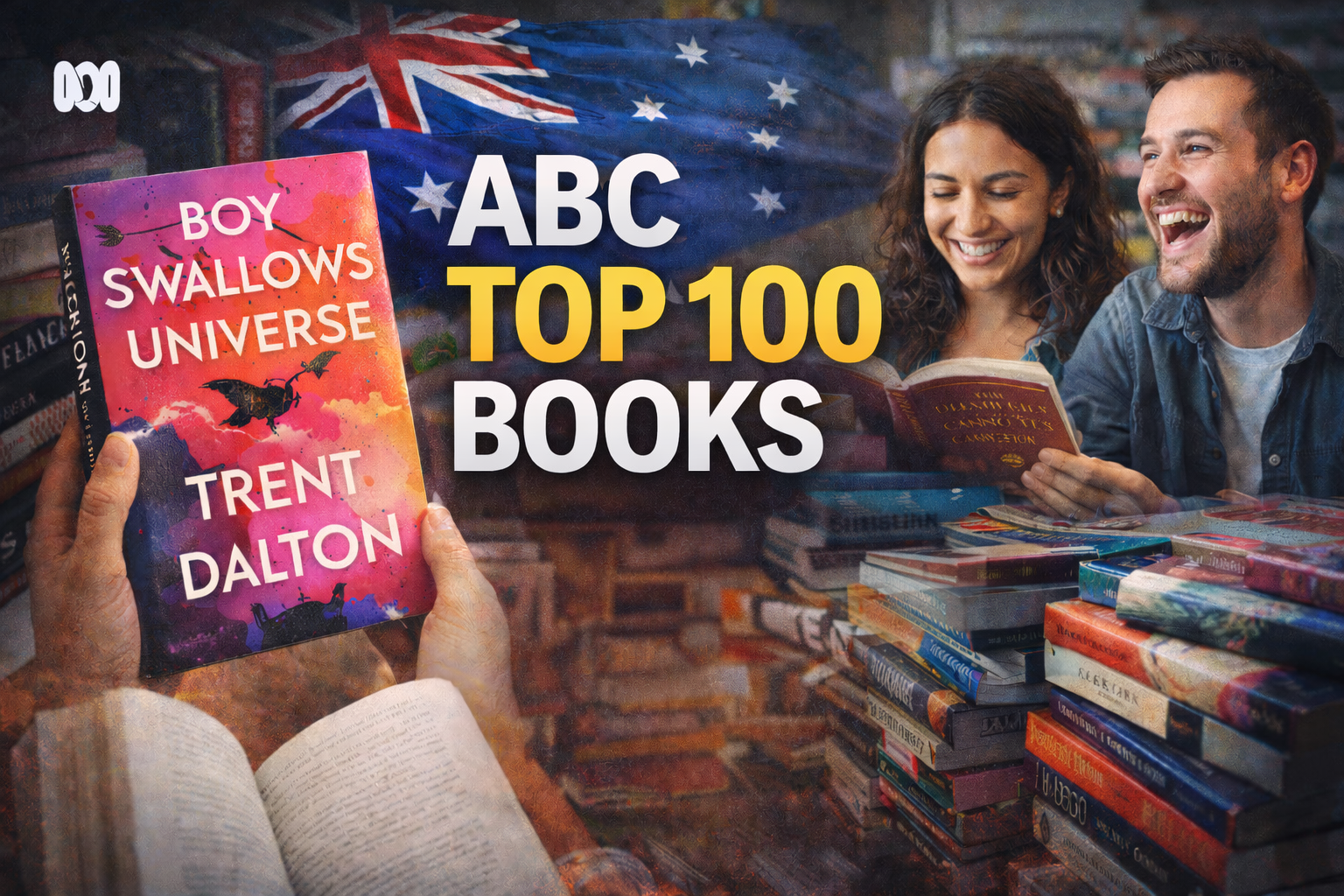
| 1 | Boy Swallows Universe | Trent Dalton | Big-hearted, vivid, local and emotionally sticky |
| 2 | The Book Thief | Markus Zusak | Beloved, widely taught, deeply felt and still heavily shared |
| 3 | A Gentleman in Moscow | Amor Towles | Elegant but warm, literary but very readable |
| 4 | All the Light We Cannot See | Anthony Doerr | Beautifully written with broad crossover appeal |
| 5 | Lessons in Chemistry | Bonnie Garmus | Book-club friendly, witty, emotional and easy to recommend |
That last point matters more than it sounds. Easy to recommend is huge. A book can be brilliant and still hard to hand to someone else. The books that rise in public polls often have recommendation energy. You can picture who you’d give them to. Your mum. Your mate. Your cousin who says they haven’t read in ages. Your colleague who wants “something good, but not too heavy.”
The ABC Top 100 Books had plenty of that energy.
Australia showed up for its own writers
Now here’s where it gets properly interesting. Australian writers did not just appear politely in the list. They stood tall in it. Two local books took the top two spots, and the wider hundred included a strong showing from Australian authors. That is not a minor detail. It says something real about confidence in local storytelling.
For years, Australian readers have lived with that old cultural twitch — the feeling that the imported thing must somehow be bigger, smarter or more important. That reflex has never fully vanished, but it looked weaker here. Readers voted in a way that said, no, a book set here, written here, shaped by local voice and local texture, can absolutely sit at the centre of the conversation.
And honestly, that feels overdue.
Australian fiction has been doing serious work for years. Regional stories, suburban stories, family stories, sharp political novels, historical reckonings, strange little masterpieces that don’t fit any clean shelf label — the range has been there. What the ABC Top 100 did was give that reality a very public scoreboard. Not a perfect one, but a vivid one.
- It showed that Australian readers are not shy about backing local books.
- It proved that a national reading list can feel local without feeling narrow.
- It gave homegrown authors a visible place in a mainstream cultural event.
That last part matters. Visibility is not everything, but it counts. A literary culture feels stronger when readers can name contemporary local books without having to think too hard.
Why Boy Swallows Universe winning felt right
Some winners arrive with a shrug. This one didn’t. Boy Swallows Universe felt like the sort of book that was always going to be hard to beat in a public vote. It has that mix of grit and tenderness readers remember. It’s Australian without feeling boxed in by “Australian novel” expectations. It moves fast. It carries pain, humour and hope in the same pair of hands. And crucially, people talk about it with feeling.
That’s the secret ingredient in lists like this. Not prestige. Feeling.
A public vote is often less about abstract greatness than about emotional residue. Which book do people still think about years later? Which one do they press into someone else’s hands and say, just read this, trust me? Which one made them laugh, cry, go quiet, send a message, buy a second copy because they gave the first away?
Boy Swallows Universe fits that pattern almost perfectly. So does The Book Thief, really. And that tells you the list was not random. It reflected a real reading instinct: Australians seem to love books that combine readability with weight. Books that carry something dark, but don’t drown in it.
The list worked because it was broad
One smart thing about the ABC setup was its range. It was not fiction only. It was not one genre. It was not limited by nation, apart from the language rule and the publication dates. That openness matters because it lets the list feel less like a gated literary exercise and more like a genuine reading commons.
That kind of breadth changes who feels invited. A thriller reader can care. A literary fiction snob can care. Someone who mostly reads memoir can care. Someone who only gets through four books a year can still care. And when more people feel welcome, the conversation gets louder, warmer and far more interesting.
There’s a practical side to this too. Broad eligibility makes the final list more useful. It becomes a browsing tool, not just a cultural statement. You can scan it looking for your next read, your holiday read, your “I need to get out of a slump” read, or the book you’ve been meaning to try since everyone started banging on about it.
That’s part of why the countdown travelled beyond hardcore book circles. It wasn’t only for the already converted. It was for people who like reading, used to like reading, want to read more, or just enjoy seeing taste turned into a public event.
| What made the countdown work | Why it clicked with readers | Cultural effect |
|---|---|---|
| Public voting | Readers felt involved rather than talked at | The list felt shared, not imposed |
| Wide genre rules | Different kinds of readers could see themselves in it | The conversation spread beyond literary circles |
| Strong local presence | Australian readers saw homegrown writing treated seriously | It boosted confidence in local book culture |
| Countdown format | People love suspense, ranking and “wait, what?” moments | Books became a live culture event, not just shelf objects |
| Recognisable favourites | The list balanced popularity with literary quality | It drew in both casual readers and devoted ones |
Why book rankings annoy people — and still work
Let’s not pretend everyone loves a ranking. Plenty of readers hate them on principle. They’ll say books aren’t horses, art shouldn’t be scored, taste is too personal, the whole thing flattens nuance. Fair enough. That critique is not silly. It’s actually pretty sensible.
But here’s the other side. Lists give people a handle. Culture is huge. Reading life is messy. Most people do not have time to survey the whole literary landscape like they’re doing a PhD. A list offers a way in. Not the final word. Just a way in.
And when the list is public, rather than handed down from a tiny circle, it gets a kind of democratic warmth. People may disagree with the order, but they understand the game. This is not saying these books are mathematically superior. It is saying: here’s what a lot of readers loved enough to vote for.
That is useful. Not perfect. Useful.
- A list gives hesitant readers a starting point.
- A list gives confident readers something to argue with.
- A list gives the wider culture a reason to talk about books again.
And that third point is gold. Books rarely get the same broad public oxygen as film, television or music. So when a reading project breaks through, even briefly, it matters.
It was a culture event, not just a reading event
That’s the bit some people miss. ABC Top 100 Books was also entertainment. Good entertainment, mind you, but still entertainment. The countdown format gave it pace. The reveals created anticipation. The reactions from authors and readers gave it texture. There was suspense, relief, smugness, disappointment and all the usual list-based chaos people secretly enjoy.
And there is nothing wrong with that. Books do not become less serious because people have fun talking about them. In fact, they often become more culturally alive when that happens. Once reading leaves the hushed room and enters the public square, it starts to behave like shared culture again. People compare notes. They build identity around what they read. They discover blind spots. They grumble. They buy things.
That last bit matters to bookshops and libraries, of course. A big public list can move real reading traffic. Not every book in the hundred gets the same lift, but visibility changes behaviour. Readers start checking what they missed. Book clubs start rethinking their schedules. Libraries see renewed interest in familiar titles. People who fell out of reading get a decent entry ramp back in.
And because the list focused on the 21st century, it also felt less dusty. This was not some museum case of worthy classics everyone pretends to have finished. These were books from the reading lives people have actually lived in recent years. That gives the whole thing a pulse.
What Australian readers seem to want now
If you had to boil the list down into a few broad reading cravings, a pattern emerges. Readers want books that move, books that matter, and books they can talk about. They like seriousness, but not stiffness. They like emotional charge, but not cheap manipulation. They like literary quality, but they do not want to be punished by it.
That is probably why titles from the top end of the list feel so broadly recognisable. They have range. They satisfy the dedicated reader and the ordinary browser at the same time. That is not compromise. It is skill.
The stronger Australian showing also hints at something else: readers here seem increasingly comfortable seeing local stories as central rather than side dishes. A Brisbane coming-of-age novel can win. A Sydney-born author can place second. Historical fiction with an Australian emotional stamp can sit proudly among global favourites. That says a lot.
It says the national bookshelf is not waiting for permission anymore.
The joy of seeing your own taste in public
There’s a small emotional thrill in lists like this, and it’s worth naming. It’s the moment you spot a book you loved and feel, weirdly, a bit seen. That feeling might sound trivial, but it’s not. Reading is private for most people. You do it alone. You carry the response quietly. Then a public countdown comes along and suddenly your solitary taste has company.
That’s part of the social life of books. A public list reassures readers that their inner shelf connects with other people’s inner shelves. It says your favourites are not floating alone in space. Other people felt that too.
And even when your favourite misses out — maybe especially then — the list still gives you something. A chance to think, argue, defend, recommend and remember. In other words, a chance to participate. That’s no small thing in a culture that often treats reading as either homework or a niche hobby.
FAQ
What is the ABC Top 100 Books project?
It is ABC Radio National’s annual public countdown where readers vote for their favourite books around a chosen theme.
What was the first theme?
The inaugural countdown focused on the top books of the 21st century so far.
Which book came first?
Boy Swallows Universe by Trent Dalton finished at number one.
Why did the list get so much attention?
Because it mixed public voting, strong reader feeling, national pride and the fun of a live countdown format.
Did Australian authors perform well?
Yes. Australian books finished first and second, and local writers had a strong presence across the wider list.
Was it just for literary fiction readers?
No. The rules were broad, which helped make the list feel open to many kinds of readers and many genres.
Why do book lists still matter?
Because they help people find new reads, compare taste, restart reading habits and turn private reading into a shared cultural conversation.
Conclusion
The ABC Top 100 Books countdown worked because it treated books like living culture, not homework and not wallpaper. It invited readers in, gave them a voice, and produced a result that felt revealing even when people disagreed with it. Maybe especially when they disagreed with it.
That’s the beauty of a list like this. It does not close the conversation. It starts one. It sends readers back to shelves, back to bookshops, back to libraries, back to old favourites and overdue discoveries. It also says something quietly encouraging about Australia right now: readers here are willing to champion local writing, celebrate emotional storytelling, and take books seriously without sucking all the fun out of them.
And really, that might be the best outcome of all. Not just one winning title, but a wider reminder that reading is still social, still personal, still full of heat. People still care. They care enough to vote, argue, recommend, defend and return to the page. For a culture site, that’s not background noise. That’s the story.