

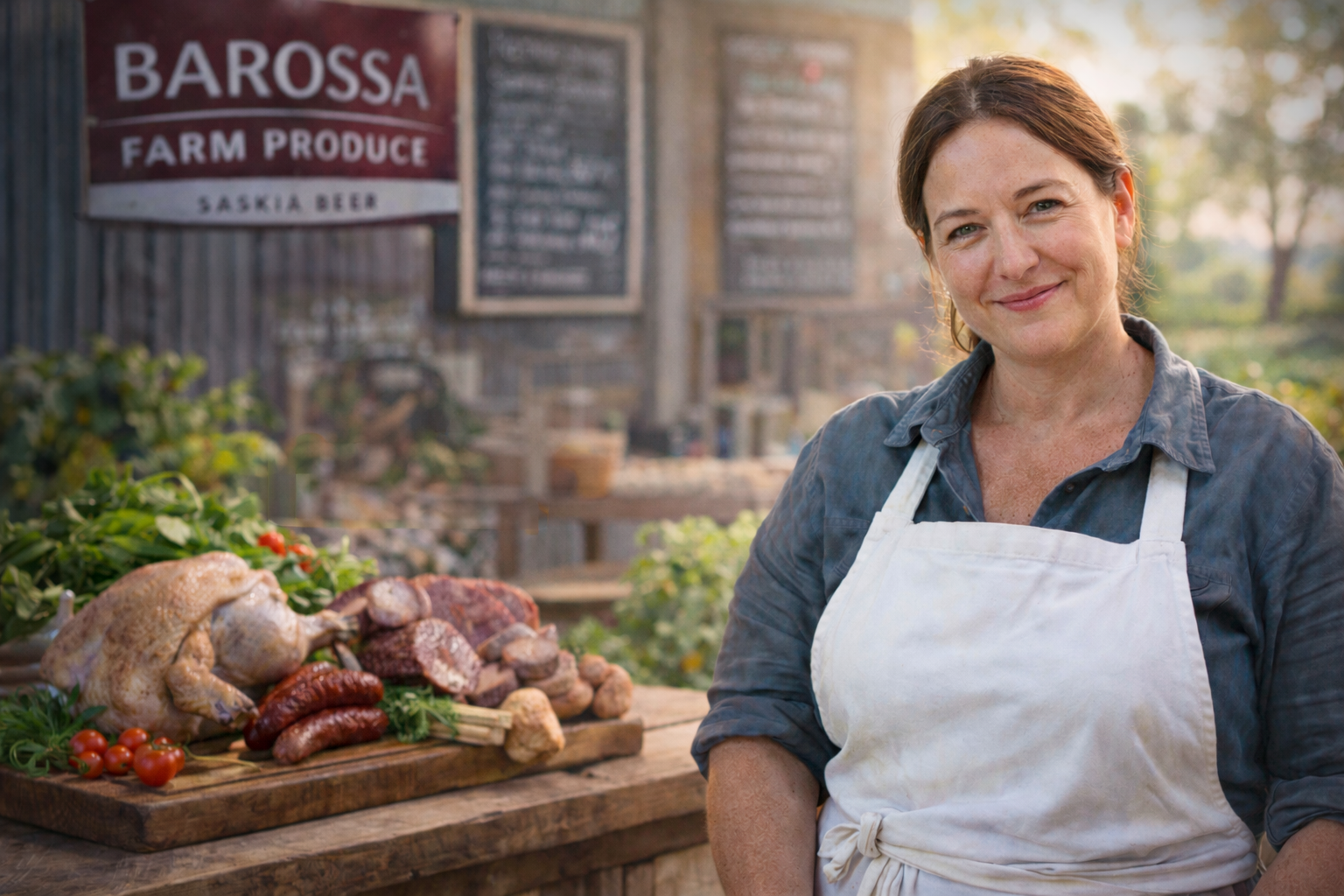
Not every public-affairs story wears a suit. Some arrive in a paddock, a market stall, a family business, a food label, a regional name people trust. That’s where Saskia Beer still sits in South Australia’s public memory. Not as a party-political figure. Not as a parliament name. But as someone whose story touches a few big Australian ideas all at once: regional identity, consumer trust, family enterprise, public accountability and what it means when a local name becomes part of the wider culture.
In South Australia, especially in the Barossa, food is never just food. It is economy, identity, tourism, regional reputation and a kind of public language. People talk about place through produce. They talk about standards through labels. They talk about community through the names attached to farms, shops, markets and kitchens. So when someone like Saskia Beer enters the public picture, the conversation is bigger than one business. It always was.
First, who was Saskia Beer?
Saskia Beer grew up inside one of South Australia’s best-known food families. She was the eldest daughter of Maggie and Colin Beer, and she built her own path in the Barossa food world rather than simply standing in her mother’s shadow. Public reporting describes her as a chef, producer, entrepreneur and a strong champion of local food culture. She launched Barossa Farm Produce in 1997, later trading as Saskia Beer Farm Produce, and became known for poultry, pork, game and a strong regional food identity.
That background matters because public identity is part of this story. Saskia Beer was not a faceless company director hidden behind packaging. She was visible. She had a name people knew. She sold products tied to place, to craft, to local pride. In Australia, and especially in regional Australia, that sort of visibility creates affection — but also scrutiny. The closer a brand stands to authenticity, the more seriously people take questions about whether that authenticity is real.
And that’s where her story moved from food culture into public affairs.
| Part of her public identity | Why it mattered | Why it still matters |
|---|---|---|
| Barossa producer | She represented a regional food story people trusted | Regional brands still trade heavily on place and reputation |
| Chef and entrepreneur | She turned family knowledge into a public-facing business | It showed how local food culture could become economic culture |
| Public family name | The Beer name carried recognition across South Australia and beyond | That visibility made questions of trust more public, not less |
| Market and hospitality presence | She was connected to real customers, not only wholesale systems | It kept her work tied to community, not just branding |
When provenance becomes a public issue
The sharpest public-affairs chapter in the Saskia Beer story came in 2014, when the ACCC accepted a court-enforceable undertaking from Barossa Farm Produce. The issue was not some tiny technical slip no one could understand. It went to the heart of what food labels mean. The ACCC said the business had made false or misleading representations about “The Black-Pig” smallgoods, including claims that the pork was from heritage Berkshire pigs or other black pig breeds, and that the pigs were free range, when that was not the case.
That episode still matters because it hits a live Australian policy question: what exactly are people buying when they pay more for a product wrapped in premium language, regional cues and heritage claims? That’s not niche. That’s consumer law. That’s market fairness. That’s trust.
And look, this is where public affairs gets real. When a producer makes a credence claim — a claim about origin, breed, method or quality that an ordinary buyer cannot easily verify by looking — the whole market depends on honesty. If those claims fail, the damage does not stop with one product line. Consumers are misled. Competitors who are doing the right thing lose ground. Faith in the label system takes a hit. The ACCC said exactly that in its wider discussion of food and grocery law.
So the Saskia Beer case did not become public merely because the name was known. It became public because the issue went beyond one person. It touched how regional food trust works in Australia.
- Consumers may pay more for claims about heritage breed, free range or regional provenance.
- Competitors who can genuinely back those claims can lose out when others cannot.
- Once trust in labels weakens, the whole premium-food market gets a little shakier.
That is why this story belongs in a public-affairs conversation. It is about markets, honesty and what regulators do when authenticity becomes a selling point.
The Barossa factor — and why place changes everything
If this had happened in a generic setting with a generic brand, it still would have mattered. But the Barossa factor changed the feel of it. The Barossa is not only a region. It is one of Australia’s most recognisable food-and-wine identities. People attach ideas to it: quality, local knowledge, long memory, craft, family business, seriousness about produce.
That means any public question about representation lands harder there. A Barossa label does cultural work before you even open the packet. It whispers a story about origin and care. It asks the buyer to trust the place, not just the product.
And that, frankly, is why provenance disputes are never dull bureaucratic footnotes. They cut into something emotional. They make people feel a bit cheated, not just financially but culturally. The buyer thought they were supporting a local truth, not just purchasing a snack or a smallgoods line. That is why these cases attract attention beyond lawyers and regulators.
In Australia, especially in regional economies, place is politics by other means. It shapes jobs, tourism, land use, branding, investment and state pride. So when a public dispute centres on what place means on a label, that’s already public life territory.
There’s a harder point here about public trust
Public trust is a strange thing. It builds slowly and breaks fast. And once it cracks, even a little, the conversation changes. People stop asking whether a name is appealing and start asking whether it is reliable. That shift is brutal. It is also fair.
The Saskia Beer story is useful because it shows both sides of trust. On one side, there was a strong public identity built on regional food culture and clear passion for produce. On the other, there was a regulatory finding that some claims were likely misleading. Those two realities sat together. They still do.
And maybe that discomfort is the most honest part of the whole story. Public life is full of people and businesses that are admired, even loved, but still answerable. Admiration is not immunity. Reputation is not a substitute for proof. In fact, the bigger the reputation, the more important the proof becomes.
That’s not cruelty. That’s the deal.
Australian readers understand this instinctively. We are not always patient with overstatement, especially when it is dressed up as local virtue. We tend to give regional producers a lot of goodwill. But once the basic trust question appears, that goodwill has conditions attached.
| Public-affairs theme | How Saskia Beer’s story connects | Why readers still care |
|---|---|---|
| Consumer law | The ACCC treated the label and marketing claims as serious enough for a court-enforceable undertaking | People want honesty when paying for premium or regional goods |
| Regional identity | The Barossa brand carries public meaning well beyond one business | Regional reputation affects entire communities, not just individual producers |
| Market fairness | Credence claims can tilt competition if they are not true | Fair competition matters to both buyers and honest producers |
| Institutional legacy | Her name now continues through a Churchill Fellowship supporting food and farming work | Legacy can shift from commerce into civic contribution |
| Public memory | Her sudden death and the community response kept her name in South Australian public life | People remember not only the controversy, but the person and the region she represented |
Then came grief, and the story changed again
Saskia Beer died unexpectedly in February 2020, aged 46. The public reporting around her death had a very different tone from the regulatory coverage years earlier. It was warm, shocked and deeply local. Tributes emphasised her drive, her skill, her support for Australian produce and her place in South Australia’s hospitality world. There was real grief in it, not the polite kind.
And this matters because public memory is rarely neat. People are not filed away into one box. Saskia Beer’s name sits in South Australian memory as both a cautionary public story about truth in food claims and a personal story of regional energy, family loss and unfinished momentum. Those things do not cancel each other out. They just sit there together, awkwardly, as real life tends to do.
Sometimes public affairs gets flattened into party lines, vote counts and government headlines. But it is wider than that. It also includes the stories a community keeps carrying because they reveal something about local institutions, values and grief. Saskia Beer became part of that sort of memory.
Her sister Elli’s more recent reflections have kept that memory in view. Not as spin. Not as image management. More as family testimony. That has given the public story a second life, one shaped less by product and more by legacy.
Legacy is where the public-interest angle becomes current again
If the story ended in 2020, it would still matter. But it didn’t end there. One of the clearest signs of Saskia Beer’s ongoing public relevance is the Churchill Fellowship established in her name. That is where the story moves from biography into civic legacy.
The Saskia Beer Churchill Fellowship was created to support innovation in food production or farming. That is not symbolic fluff. It is a real pipeline for future work. The projects it has backed give a pretty good sense of the values now attached to her name: traditional food skills, bee health, climate-resilient agriculture and broader questions of how Australia feeds itself well and honestly.
That shift is significant. A name once attached to a business controversy is now also attached to national learning, research travel and community benefit. That does not erase the earlier chapter. It reframes the ongoing public meaning. It says legacy can be active, not frozen.
- The fellowship turns memory into something practical.
- It links food culture with public benefit, not just private enterprise.
- It keeps Saskia Beer’s name in living Australian conversations about agriculture, skills and resilience.
And really, that is public affairs in a very Australian register. Not grand speeches. Not flag-waving. Just the steady work of taking a name, a family history and a regional story, and turning them into something that may help the country think better about food and farming.
Why this still speaks to politics, even without politicians
Here’s the bit worth spelling out. Food provenance is political. Not in the party-war sense. In the everyday governance sense. Who checks claims? Who pays when labels mislead? How do regulators protect both consumers and honest producers? What role do regional brands play in the national economy? How much trust can markets demand without showing evidence?
Those are political questions. They sit right inside public administration, regulation, competition, regional development and consumer rights. So when people wonder why a story like Saskia Beer belongs in a public-affairs section, the answer is simple: because it says something concrete about how public systems respond when cultural capital meets market claims.
There is also a softer politics here — the politics of local pride. South Australia, especially food-focused South Australia, has long built part of its public identity around quality, craft and regional excellence. Saskia Beer’s story fits inside that larger state narrative. She was one of the visible faces of it. Which means the highs and lows of her public story also reflected on a wider idea of what South Australian food culture wanted to be.
That is why the name still carries a bit of charge. It is not only about a person. It is about a model of regional public life.
A story about standards, but also about human mess
If you strip away the public language, what remains is a very human story. A daughter in a famous family trying to build her own standing. A business tied tightly to authenticity. A regulator stepping in when the claims did not stack up. A region reacting. A sudden death. A family carrying grief. A fellowship carrying the name forward.
That’s a lot. And maybe that is why the story lasts. It refuses to stay in one category.
Some readers will focus on the consumer-law part, and fair enough. Some will focus on the Barossa identity part. Some will think first of Maggie Beer and the family story. Others will think about the fellowship and the way legacy can be redirected into public good. All of those readings are available because the public record is layered.
And layered stories are usually the ones worth keeping.
FAQ
Who was Saskia Beer?
Saskia Beer was a South Australian chef, producer and food entrepreneur from the Barossa, known for building her own farm-produce business and championing regional food culture.
Why does she fit a public-affairs conversation?
Because her story touches consumer law, food provenance, regional identity, market trust and civic legacy — all of which sit squarely in public life.
What was the ACCC issue about?
In 2014, the ACCC accepted a court-enforceable undertaking after Barossa Farm Produce acknowledged likely misleading claims about “The Black-Pig” products, including breed and free-range representations.
Why are food-label cases such a big deal?
Because buyers cannot easily verify many premium claims themselves, so the whole system depends on honest representations and fair enforcement.
Did Saskia Beer’s story end with that controversy?
No. Her public story also includes a strong regional reputation, community grief after her sudden death in 2020, and a continuing legacy through the Churchill Fellowship in her name.
What is the Saskia Beer Churchill Fellowship?
It is a fellowship established to support innovation in food production or farming, helping Australians travel, learn and bring useful ideas back home.
Why do Australians still respond to her story?
Because it combines things people care about deeply here: local produce, regional pride, public trust, fairness in markets and the way families carry legacy forward.
Conclusion
Saskia Beer still matters in Australian public life because her story says more than one thing at once. It says that regional names carry weight. It says public trust is precious and fragile. It says regulators matter when markets trade on authenticity. And it says legacy can keep moving long after the original person is gone.
For a Politics & Public Affairs reader, that is the real value of this topic. Not gossip. Not nostalgia. A close-up look at how culture, law, markets and memory overlap in one recognisable South Australian story.
And maybe that is why the name still lands. Saskia Beer is remembered not only as a food figure, but as part of a larger Australian argument about truth, place and what people owe each other when trust becomes part of the product. That argument is still alive. Which means, in a very real sense, so is the public relevance of her story.