

Why david pye Still Dictates How We View Craftsmanship Today
Have you ever wondered why david pye remains an absolute legend when you are sitting in a local Kyiv coffee shop, staring at a hand-carved wooden stool, and thinking about what makes it so special? I was having a strong espresso down near Podil just last week, tracing my fingers over the intricate, slightly uneven joinery of the barista’s countertop, and it suddenly hit me hard. We are absolutely still living and breathing in the design framework established decades ago by this exact thinker. He basically cracked the code on why we instinctively value handmade, organic things over cold, machine-made perfection.
His core ideas resonate deeply here in Ukraine, especially right now in 2026, as we fiercely rebuild our spaces and pour our souls into restoring local architecture and traditional crafts. We are looking at a fundamental, seismic shift in how we perceive the objects we forge with our bare hands versus the sterile items we mass-produce in gigantic factories. His groundbreaking philosophy of the “workmanship of risk” completely changes how you appreciate everyday objects around you. I want to share exactly how his theories apply directly to your own creative projects, whether you are shaping rough wood, coding intricate software, or kneading sourdough bread. Let’s break down his brilliant perspective on design, uncertainty, and human creativity, because quite frankly, it is more incredibly relevant now than ever before.
Read also: Who Is sebastian robinson? A Guide; Sharnelle Vella: The Complete Guide to Her Legacy.
Getting the hang of his concepts offers a massive, immediate benefit for anyone who makes things for a living or a hobby. The core value proposition here is pure clarity. When you finally understand the profound difference between risk and certainty in production, you immediately stop stressing over making a piece of bespoke furniture or a handmade ceramic bowl look like a soulless factory produced it. You start intentionally embracing the slight, beautiful imperfections because they are the ultimate proof a living, breathing human was there. For example, a hand-turned wooden bowl might have slight tool marks on the bottom—that is a massive benefit, not a flaw, adding immense aesthetic and monetary value. Another example is traditional calligraphy; a slight, unpredictable variation in ink pressure makes it high art rather than mere digital typography.
| Concept | Core Definition | Real-World Example Outcome |
|---|---|---|
| Workmanship of Risk | Quality depends entirely on the maker’s moment-by-moment physical judgment and focus. | A meticulously hand-carved wooden spoon featuring unique, unrepeatable grain patterns. |
| Workmanship of Certainty | Quality is mathematically predetermined before the actual production process even begins. | A perfectly uniform, plastic injection-molded spoon from a massive commercial factory. |
| Regulating Work | Applying tools, jigs, or guides that limit the risk and physical freedom during creation. | Using a heavy steel ruler to draw a perfectly straight line instead of freehanding it. |
You can practically see this tension at play when you decide to build something yourself instead of ordering it from a giant big-box retailer. There are three major, life-altering takeaways you get from applying his resilient mindset to your daily tasks and hobbies:
- You develop a significantly healthier relationship with your inevitable mistakes, viewing them as organic, highly necessary elements of the creative process rather than utter, soul-crushing failures.
- You learn to choose your workshop tools much more deliberately, finding the perfect balance between when to use a rigid guide and when to bravely freehand a difficult cut.
- You instantly and dramatically increase the perceived value of your finished work by proudly highlighting the human element rather than desperately trying to hide it behind sanding and polish.
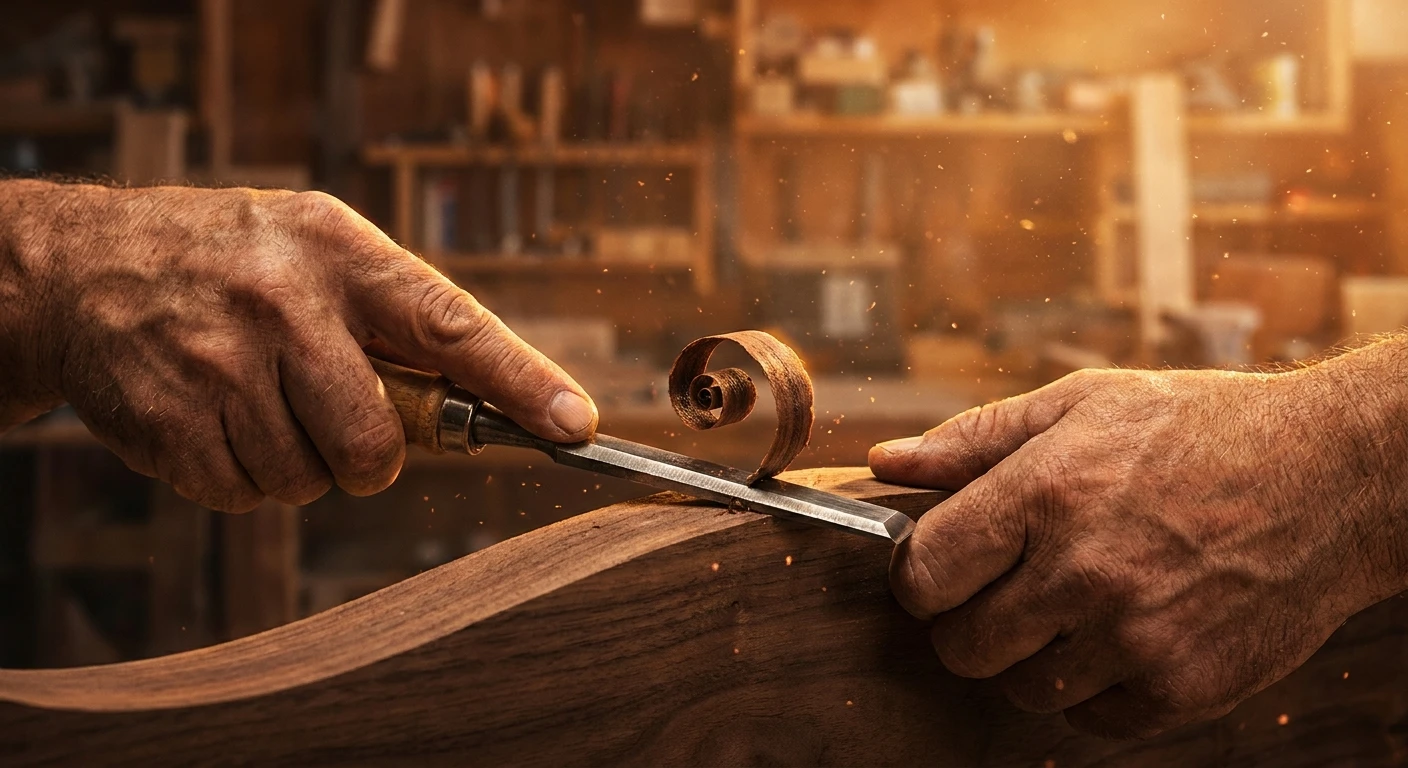
It is genuinely fascinating how liberating this specific mindset is for a creator. You are no longer hopelessly competing with a million-dollar CNC machine. Instead, you are offering the world something a machine literally cannot ever produce: genuine human risk. Every single time a woodworker puts a sharp steel chisel to a rapidly spinning lathe, there is a tangible, terrifying chance the piece could shatter or chip into a dozen pieces. The very fact that it didn’t, and that the elegant shape emerged beautifully from the chaos, is exactly what gives the object its eternal soul. This is the raw essence of his teaching. The tightrope walk between complete ruin and total success is where the magic truly lives.
The Origins of His Design Philosophy
So where did all this brilliant theory actually start? Before he wrote his seminal, paradigm-shifting texts, the academic design world was heavily obsessed with the legacy of the old Arts and Crafts movement. Thinkers like John Ruskin and William Morris often blindly hated machines, viewing industrialization as a moral evil that destroyed art. He looked at this romanticized worldview and thought it was intellectually lazy and practically useless. Born in 1914, his early life was entirely surrounded by massive, unstoppable industrial shifts across Europe. He formally trained as an architect and later proudly served in the Royal Navy. This intensely practical background meant he wasn’t just sitting in an ivory tower philosophizing about beauty; he was dealing with real, stubborn materials, massive naval ships, and structural integrity. He recognized early on that machines weren’t inherently evil monsters, but they undeniably changed the fundamental nature of how things were constructed and valued.
Evolution of the Workmanship Concept
As he gracefully transitioned into the world of academia, eventually becoming the highly respected Professor of Furniture Design at the Royal College of Art in London, his ideas significantly matured and sharpened. He realized that the old, tired debate of “man vs. machine” was entirely the wrong argument to be having. The real, juicy debate was exclusively about the process of making itself. In 1968, he published his absolute masterpiece, The Nature and Art of Workmanship. This single book practically exploded the traditional design theory landscape. He brilliantly introduced his famous dichotomy between risk and certainty. He boldly argued that the true quality of an object shouldn’t be judged just by its clever design on a piece of paper, but by the physical execution at the workbench. The steady evolution of his thought brought a pragmatic, almost engineer-like precision to fuzzy aesthetic theory. It gave critics, historians, and actual makers a brand new, highly accurate vocabulary to discuss why a perfectly smooth factory table felt completely “dead,” while a slightly uneven, hand-planed table felt wonderfully “alive.”
The Modern State of His Influence
Fast forward to our current era, and his robust concepts are absolutely foundational in top-tier design schools globally. With the exponential rise of cheap 3D printing, complex AI-generated art, and hyper-automated smart manufacturing in 2026, the sharp distinction between human risk and algorithmic certainty is our absolute best tool for defining what actually constitutes human craft. Crafters, artisans, and small business owners now constantly use his terminology to proudly defend their premium pricing and their painstakingly slow methods. The modern state of high-end handmade goods owes a massive, unpayable debt to his unique ability to articulate the invisible value of human sweat and effort. We don’t just buy a wooden chair; we are literally buying the documented, physical survival of a high-risk process.
The Mechanics of Risk and Certainty
Let’s get a bit deeply technical about how this actually works on a physical, neurological level. When we passionately talk about the “workmanship of risk,” we are essentially discussing intense, real-time feedback loops happening inside human motor control systems. In cognitive science and biomechanics, this highly involves proprioception and micro-fine-motor adjustments. When a master craftsperson uses a traditional hand saw, their brain is constantly, frantically receiving tactile data from the resistance of the wood grain, instantly adjusting the precise angle, speed, and pressure of their shoulder muscles millisecond by millisecond. If their attention drops for even a fraction of a second, the saw wanders off the line, and the expensive piece of mahogany is totally ruined. The final outcome is absolutely not guaranteed until the very last, satisfying stroke of the blade is finished and the offcut falls to the floor.
Regulating Jigs and Degrees of Freedom
On the flip side, the “workmanship of certainty” aggressively eliminates these pesky degrees of human freedom through rigid engineering. A physical jig, a metal mold, or a complex CNC computer program pre-calculates all the dangerous variables before the machine even turns on. The specific technical term he used for introducing this kind of control into a previously risky process is “regulating work.” By firmly clamping a straight fence to a table saw, you instantly restrict the wood’s chaotic movement to a single, safe axis. You drastically reduce both the intense cognitive load on the operator’s brain and the physical risk of a disastrous error. Here are some highly specific technical facts regarding how this delicate balance functions in actual workshop practice:
- The true degree of risk is highly variable; almost absolutely no manufacturing process on earth is 100% pure, unadulterated risk or 100% pure certainty.
- Even the most highly automated, multi-million-dollar factory systems require a terrifying “risk” phase during the initial setup, calibration, and prototyping by human engineers.
- “Diversity” in the manufacturing lexicon directly refers to the slight, inevitable, organic variations present in handmade goods, mathematically proving a living human’s physical involvement.
- True tool dexterity relies heavily on a complex combination of visual tracking and tactile sensory input to successfully mitigate risk during high-stakes execution.
Deeply understanding these physical mechanics allows modern designers to intentionally, strategically inject raw risk back into their otherwise sterile processes. By choosing exactly which tedious steps to completely automate and which delicate steps to stubbornly leave to hand-control, makers can successfully scale their production volume without losing the beating soul of the object. It is a precise, beautiful calibration of human neurology against raw material physics.
You definitely don’t need to be a master woodworker with thirty years of experience to apply this directly to your life. You can seamlessly integrate this robust philosophy into your daily routine, your career, and your weekend hobbies. Here is a comprehensive, highly actionable 7-step plan to start recognizing and utilizing the workmanship of risk over the next week. Grab a notebook and let’s get started.
Step 1: Audit Your Possessions
Look closely around your house today. Actively identify five objects made with total, flawless certainty (like a cheap plastic phone case or a stamped metal fork) and five objects made with intense risk (a knitted wool scarf, a heavily textured oil painting, or a hand-thrown ceramic mug). Notice exactly how they make you feel differently when you touch them.
Step 2: Try a High-Risk Task
Tomorrow, grab a blank piece of paper and try drawing a perfectly round circle completely freehand with a dark ink pen. Feel the rising tension in your wrist as you attempt to close the loop smoothly. That specific anxiety? That is the pure, unfiltered essence of raw, unregulated craftsmanship.
Step 3: Introduce a Regulating Jig
On the third day, draw that exact same sized circle using a metal drafting compass. Experience the massive difference in cognitive load and physical stress. You have just successfully shifted your process from terrifying risk to boring certainty.
Step 4: Analyze the Results
Compare the two circles side by side under a bright light. The compass circle is absolutely perfect, but it is incredibly boring to look at. The freehand circle is undeniably flawed, a bit wobbly, but it has genuine character and visibly tells a story of your hand’s unique micro-tremors.
Step 5: Cook Without a Recipe
Next, fiercely apply this concept to the kitchen. Make dinner completely without using measuring cups or scales. Add spices based purely on taste, smell, and intuition. You are boldly introducing high risk into the culinary process. If it ruins the dish, you learn a harsh lesson. If it works, it’s a brilliant, unrepeatable masterpiece.
Step 6: Identify Fake Risk
Go to a local clothing store and look specifically for mass-produced items maliciously designed to look handmade (like faux distress marks perfectly replicated on a thousand pairs of factory jeans). This is the modern industry cynically trying to mimic risk. Train your eye to spot this fake diversity instantly.
Step 7: Create Your Hybrid Project
Finally, start a small weekend project—like building a wooden birdhouse, coding a simple script, or knitting a pair of socks. Use rigid jigs and automated tools exactly where you need absolute structural integrity, but fiercely leave the aesthetic finishing touches completely to your unregulated hand. Find your absolute perfect balance.
There is a lot of bizarre misunderstanding floating around the internet about historical design theory. Let’s aggressively clear up some of the most stubborn, common misconceptions right now.
Myth: The workmanship of risk means making things incredibly dangerously, carelessly, or without any regard for personal workshop safety.
Reality: It simply means the quality of the final result is continually dependent on the maker’s sharp judgment and physical skill during the process; it has absolutely nothing to do with a lack of safety goggles.
Myth: He genuinely believed machines and modern automation were completely evil and ruined the purity of global design.
Reality: He actually forcefully argued that the workmanship of certainty (machines) is absolutely necessary and wonderful for sustaining modern civilization. He just wanted us to clearly understand the stark difference and value both methods appropriately.
Myth: Only traditional, dusty crafts like woodworking, blacksmithing, or pottery strictly apply to these old academic rules.
Reality: You can beautifully apply his robust concepts to almost anything, from writing elegant software code and cooking gourmet meals to playing live, improvised jazz music versus hitting play on a pre-recorded digital track. The thrilling tension of live execution exists literally everywhere.
Who exactly was he?
He was a highly prominent British architect, brilliant industrial designer, and deeply respected professor at the prestigious Royal College of Art in London.
What is his most famous book?
The Nature and Art of Workmanship, originally published in 1968, absolutely remains his most influential and widely cited text.
What is the workmanship of risk?
A physical process where the quality of the final outcome is continually at risk during making and depends entirely on the maker’s intense care, dexterity, and judgment.
What is the workmanship of certainty?
A highly regulated production method where the outcome’s exact quality is predetermined and completely outside the human maker’s control once the automated process actually begins.
Did he hate mass production?
Not at all. He fully recognized its absolute necessity for feeding and clothing the world but wanted a precise, scientific language to separate it from pure handcraft.
How does this apply in 2026?
With generative AI and extreme robotic automation everywhere, clearly defining what makes a human touch valuable is critical for our mental and economic survival.
Where can I learn more?
Finding and reading his original, insightful books is easily the absolute best starting point for any serious maker or curious designer.
Grasping the philosophy of david pye completely and permanently shifts how you view the built environment around you. It grants you the ultimate permission to boldly value the human hand, the slight, beautiful error, and the brilliant, terrifying tension of physical creation. Go look at your latest unfinished project sitting on your desk right now—embrace the inherent risk and go create something absolutely unforgettable!