

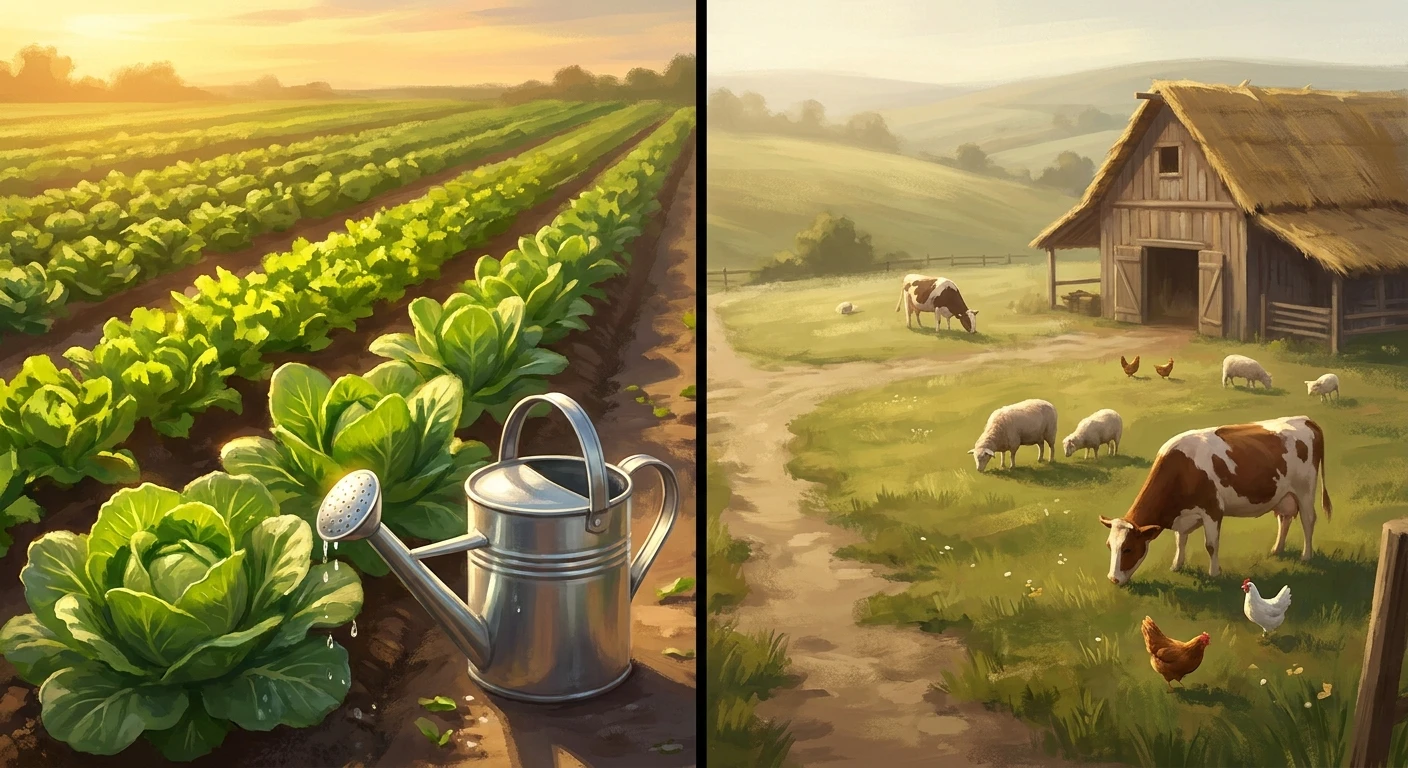
Deciding Between Stardew Valley Rancher or Tiller Professions
Reaching Farming Level 5 triggers one of the most impactful early-game decisions for any player. The choice between the Stardew Valley Rancher or Tiller profession dictates the fundamental economic engine of your virtual homestead. Whether you want to prioritize vast fields of crops or focus on raising livestock, this single selection shifts the profit margins of your daily activities. If you pick the wrong one for your playstyle, your gold generation can stagnate just when you need it most for house upgrades and community center bundles. The Stardew Valley Rancher or Tiller debate centers entirely on where you plan to invest your time, energy, and virtual real estate as the seasons progress.
Tiller instantly adds a flat 10% value increase to raw crops, pushing early-game farming into high gear. Rancher provides a 20% bump to raw animal products, incentivizing the rapid construction of barns and coops. The immediate economic impact on your day-to-day gameplay is massive. Your morning routine changes based on this choice. A player focused on crops spends the morning watering and harvesting, maximizing field space. A player prioritizing animals spends time petting cows, shearing sheep, and gathering eggs. Understanding the long-term mathematical implications of this fork in the skill tree ensures maximum efficiency. The path you take directly influences the Level 10 specialization options, meaning a decision made in Spring Year 1 echoes all the way to late-game perfection.
Read also: Choosing Miner or Geologist Stardew Valley Professions; Is Party Animals Crossplay Supported? Find Out Here.
Core Economic Benefits and Mechanics
Making a heavily informed decision requires looking past the immediate Level 5 bonuses and analyzing the downstream effects. The choice fundamentally locks you into specific value propositions that scale differently as you acquire more advanced farm equipment. Here is a clear breakdown of how the two paths compare when looking at their ultimate trajectories.
| Feature | Tiller Profession | Rancher Profession |
|---|---|---|
| Level 5 Bonus | Crops sell for 10% more gold | Animal products sell for 20% more gold |
| Level 10 Option A | Artisan (Processed goods worth 40% more) | Coopmaster (Coop animals befriend quicker, incubation halved) |
| Level 10 Option B | Agriculturist (Crops grow 10% faster) | Shepherd (Barn animals befriend quicker, sheep produce wool faster) |
The economic impacts stretch across three distinct phases of your playthrough:
- Early Game Cash Flow: Tiller provides an immediate, reliable boost to raw vegetable and fruit sales, generating the capital needed for basic tool upgrades and backpack expansions.
- Mid-Game Processing: As you unlock preserves jars and kegs, the Tiller path (leading to Artisan) creates an exponential profit loop that rapidly accelerates wealth.
- Late-Game Automation: Rancher offers incredibly low-maintenance income. Autopetters and auto-grabbers reduce daily chores to zero, allowing players to focus entirely on Skull Cavern runs or ginger island exploration.
The value proposition for Tiller becomes undeniable when evaluating the Artisan profession. For example, turning a standard Melon into Melon Wine multiplies its base value significantly. With the 40% Artisan bonus, that single bottle of wine becomes one of the highest-grossing items in the game. Alternatively, the Rancher path offers specific quality-of-life benefits for livestock managers. For example, a Shepherd player can maximize sheep wool production, turning a barn full of sheep into a daily fabric factory, while a Coopmaster can rapidly incubate dinosaur eggs for an entirely passive prehistoric farm. Both paths offer viable, highly lucrative endpoints depending on your tolerance for micromanagement versus passive income.
Origins of Farming Professions
The skill system in Stardew Valley was designed to give players a sense of RPG progression within a relaxing farming simulation. Originally, the developer, Eric Barone (ConcernedApe), wanted distinct archetypes for farm life. In the earliest builds of the game, the divide between crop farming and animal husbandry was stark. Crops required constant energy expenditure, while animals required immense gold investment for housing and fodder. The Level 5 choice was intended to reward whichever playstyle the player naturally gravitated toward during their first few weeks in Pelican Town.
Evolution of Skill Trees
As the game evolved through multiple major content updates, the balance between these two branches shifted dramatically. In early versions, the Tiller path, specifically the Artisan profession, mathematically outclassed every other income method. Massive sheds filled with kegs processing Ancient Fruit wine became the absolute meta. Animal products simply could not compete with the sheer volume of gold generated by an optimized crop farm. Updates like 1.4 and 1.5 introduced new animal products like dinosaur mayonnaise and ostrich eggs, alongside quality-of-life items like the auto-petter. These additions slowly bridged the gap, making the Rancher path highly desirable for players who found crop management tedious.
Modern State of Farm Economics
Today, the economic meta still slightly favors the Tiller-to-Artisan pipeline for pure maximum profit. However, the Rancher path is entirely viable and favored by many veteran players for its time-saving benefits. A fully upgraded barn of pigs hunting truffles provides astronomical daily profits without the need to replant seeds or optimize sprinkler layouts. The modern state of the game allows for incredible flexibility. Players no longer feel permanently punished for choosing animals over crops, thanks to the careful rebalancing of animal product base prices and processing times.
The Mathematics of Profit Margins
Understanding the backend calculations of Stardew Valley demystifies why certain items sell for massive amounts of gold. The game determines an item’s sell price by taking a hardcoded base value and applying quality multipliers (Silver is 1.25x, Gold is 1.5x, Iridium is 2x). When a profession bonus is applied, the game takes the final quality-adjusted price and multiplies it again. Tiller adds a 1.1x multiplier to raw crops, while Rancher adds a 1.2x multiplier to raw animal goods. However, the most critical math happens during processing.
Processing Times and Economic Multipliers
When you place a crop in a keg or an egg in a mayonnaise machine, the game strips away the original item’s quality (except for Ostrich Eggs). The machine then calculates a new base price. A keg multiplies a fruit’s base value by 3. A preserves jar multiplies the base value by 2 and adds 50 gold. The Artisan profession then applies a massive 1.4x multiplier to this final processed number. This compounding math is what makes the Tiller path so incredibly dominant in late-game scenarios. Here are some scientific facts regarding the game’s internal mechanics:
- Crop growth is calculated in overnight integer ticks; a crop planted on Day 1 that takes 4 days will be ready on Day 5.
- The Agriculturist profession reduces growth time by 10%, rounding down. This can shave entire days off long-growing crops like Starfruit.
- Animal friendship is tracked on a scale from 0 to 1000 points (each heart represents 200 points).
- Petting an animal grants 15 points, while the Coopmaster and Shepherd professions increase this daily gain, severely reducing the time it takes to reach maximum product quality.
- Truffles are mathematically classified as forage items when picked up, but they benefit from the Artisan profession when pressed into Truffle Oil.
Step 1: Assess Your Daily Routine
Before you hit Level 5 Farming, pay attention to what you enjoy doing most in the game. If you despise watering crops and prefer tending to chickens, your choice will naturally lean toward Rancher. If you love the visual satisfaction of a massive harvest, Tiller is the right path.
Step 2: Calculate Early Game Needs
In Spring Year 1, gold is scarce. Tiller provides an immediate 10% boost to crops like Potatoes and Strawberries. If you are rushing to complete the Community Center, this extra cash flow can fund the necessary barn and coop upgrades much faster than relying purely on early-game mayonnaise.
Step 3: Plan Your Barns and Coops
If you choose Rancher, you need a blueprint for expansion. You must prioritize Robin’s construction services to upgrade to Big and Deluxe animal housing. Reaching the Deluxe Barn unlocks pigs, which are arguably the most lucrative animal in the entire game.
Step 4: Map Out Crop Layouts
For Tiller players, planning sprinkler coverage is paramount. Once you unlock Quality Sprinklers, your crop fields can expand infinitely. Map out your scarecrow radius and sprinkler grids to maximize the 10% profit boost across hundreds of tiles.
Step 5: Choose at Level 5
When the screen pauses in the middle of the night, lock in your decision based on your infrastructure. If you have two coops and a barn already, Rancher will pay off instantly. If you just planted 200 blueberries for Summer, take Tiller.
Step 6: Prepare for Level 10 Specializations
As you approach Level 10, start stockpiling goods. If you are on the Tiller path aiming for Artisan, hoard your wine, jelly, and cheese in chests. Do not sell them until the night you hit Level 10 to instantly benefit from the 40% retroactive price jump.
Step 7: Utilize the Statue of Uncertainty
If you regret your choice, there is a built-in mechanic to reverse it. Once you unlock the Sewers by donating 60 items to the Museum, you can pay the Statue of Uncertainty 10,000 gold to change your profession. This allows you to use Tiller for early crop growth and switch to Rancher later, or vice versa.
Myths & Reality
Myth: Rancher is completely useless in the late game and makes no money.
Reality: A late-game farm focusing purely on pigs for truffles or ostriches can generate hundreds of thousands of gold daily. When combined with the Gatherer/Botanist foraging professions for iridium truffles, Rancher builds are incredibly wealthy.
Myth: Tiller only matters if you plan to make massive sheds full of wine kegs.
Reality: The flat 10% raw crop boost is a massive help during the entirety of Year 1. Even if you never build a single keg, selling raw gold-star pumpkins and melons with the Tiller buff provides a highly comfortable income.
Myth: You are permanently locked into your Level 5 choice forever.
Reality: For 10,000 gold at the Statue of Uncertainty in the Sewers, you can reset your farming skill tree overnight. Many veteran players swap professions multiple times a year depending on the season and their current stockpile of goods.
Myth: Animal products do not benefit from the Artisan profession.
Reality: Artisan heavily buffs cheese, mayonnaise, cloth, and truffle oil. Paradoxically, the best profession for an animal-focused farm in the late game is actually the Tiller/Artisan path, not Rancher.
Does Tiller affect forage items?
No, Tiller strictly applies to items classified as crops. Foraged items like wild plums, spring onions, and truffles fall under the Foraging skill tree and benefit from the Gatherer and Botanist professions.
Do Truffles count for Rancher?
No. Even though pigs find them, the game code classifies truffles as forage. However, if you turn the truffle into Truffle Oil, it becomes an Artisan Good and benefits from the Artisan profession.
Which profession makes more gold overall?
Mathematically, the Tiller path leading to Artisan produces the highest possible gross income in the game, specifically through Ancient Fruit or Starfruit wine aged in casks.
Does Tiller boost Ancient Fruit?
Yes, raw Ancient Fruit sells for 10% more with Tiller. However, you should almost always process Ancient Fruit into wine, which requires the Level 10 Artisan skill to maximize profit.
Can Coopmaster speed up dinosaur incubation?
Yes. The Coopmaster profession halves the time required for all eggs in an incubator, dropping the lengthy dinosaur egg hatch time from 12 days down to just 6 days.
Does Shepherd affect pig friendship?
Yes. Pigs are housed in barns, so the Shepherd profession causes them to gain friendship points faster. Higher friendship means a higher chance for multiple truffle spawns per day.
When should I switch professions?
Many players take Tiller for the early game, switch to Agriculturist (via the Statue of Uncertainty) at the start of a season to make crops grow faster, and then switch to Artisan at the end of the season before selling their processed goods.
Conclusion
The choice between Stardew Valley Rancher or Tiller defines your farm’s early trajectory and dictates your daily schedule. Tiller offers unmatched scaling potential through crop processing and artisan goods, making it the undisputed king of absolute profit. Rancher provides a charming, reliable, and eventually low-maintenance alternative for players who prefer tending to livestock over optimizing sprinkler grids. Because the game allows you to change your mind later at the Statue of Uncertainty, you can experiment freely without fear of ruining your save file. Boot up your game, assess your current farm layout, and make the choice that best fits your ultimate vision for Pelican Town!