

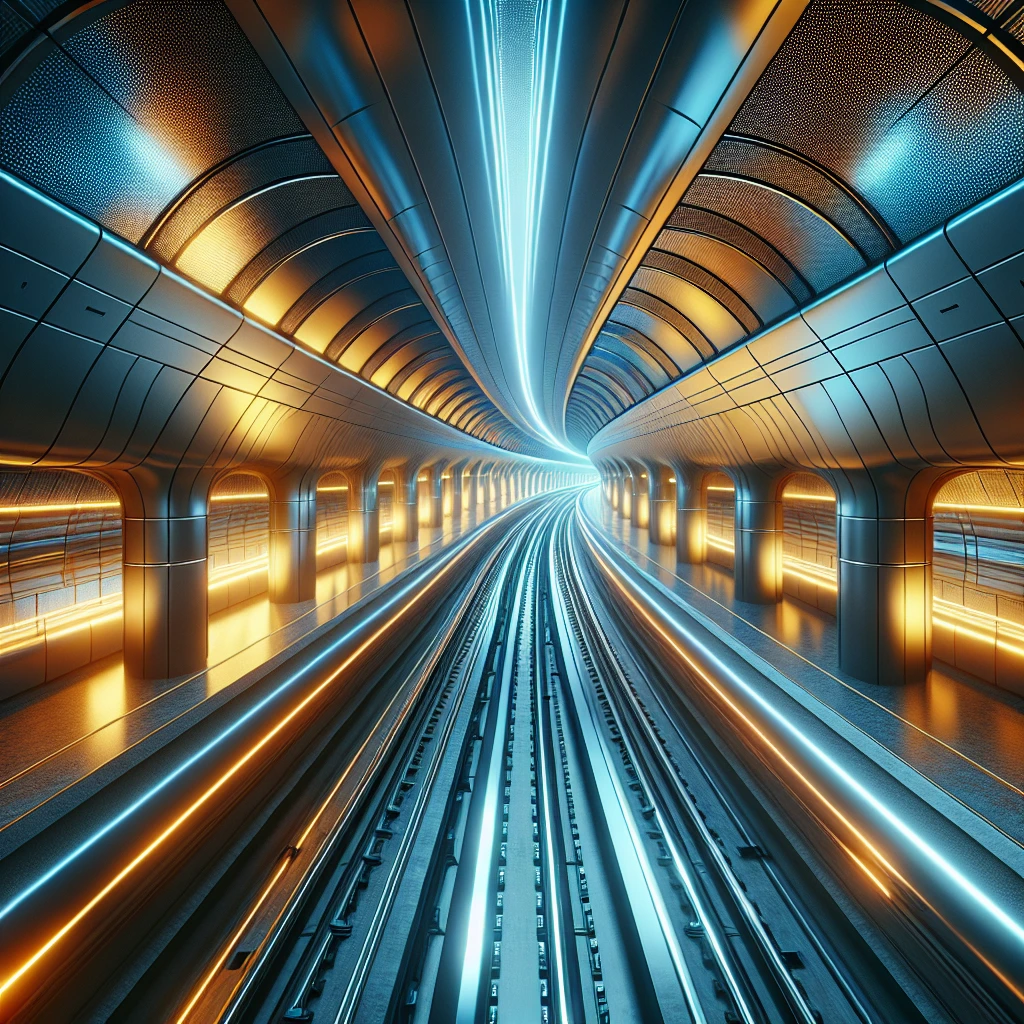
What Actually Happens Inside a Metro Tunnel?
Have you ever looked out the window of a speeding train and wondered what exactly is hiding inside that dark metro tunnel blurring past your eyes? You are definitely not the only one. Most of us just stare at our phones, totally ignoring the massive subterranean network holding the city together. But honestly, the engineering happening right outside that train window is absolutely mind-blowing.
When I was living near the Syrets station in Kyiv, I used to feel the faint rumbling of the green line deep underground. It felt like the actual heartbeat of the whole neighborhood. I remember standing on the platform, staring out into the pitch-black void, imagining the massive concrete rings, the heavy-duty cables, and the sheer volume of earth sitting just above our heads. Kyiv has some of the deepest stations on the planet, and realizing you are standing under a literal mountain of dirt and rock puts things into perspective quickly.
The entire concept of building underground seems wild when you really think about it. You have to move millions of tons of dirt, navigate around buried pipes, avoid collapsing buildings, and somehow create a perfectly smooth path for heavy metal trains to run on tight schedules. My goal here is to break down exactly how these dark passages function. Trust me, once you understand the mechanics, you will never look at your daily commute the same way again.
The Core Mechanics of Underground Transit Systems
Listen, you probably think a metro tunnel is just a giant hollow pipe buried in the dirt. I used to think the exact same thing. But an active transit tube is more like a living, breathing machine. It requires constant maintenance, airflow, and power regulation to keep everything from instantly falling apart. The space is tightly packed with specialized equipment. Every inch is optimized for safety and efficiency.
Let’s talk about the real value these structures bring to our cities. First, they provide unbelievable traffic bypass capabilities. Look at London—without the Underground, the streets above would literally gridlock into a permanent standstill. Millions of people bypass the chaos above every single day. Second, they act as massive climate-controlled corridors. While it might be freezing winter or scorching summer on the surface, the deep underground maintains a remarkably stable temperature, saving enormous amounts of energy on train heating and cooling.
Here is a quick look at the three main ways engineers actually build these massive pathways:
| Construction Method | Typical Depth Profile | City Disruption Level |
|---|---|---|
| Cut-and-Cover | Shallow (just beneath the street) | Massive (requires tearing up roads) |
| Deep Bore (TBM) | Very Deep (often below bedrock) | Minimal (completely hidden underground) |
| Immersed Tube | Underwater (crossing rivers/bays) | Moderate (affects marine traffic) |
If you want to know what makes a metro tunnel actually function on a daily basis, it comes down to three main survival systems:
- Active Ventilation: Massive fans pull fresh air from hidden street-level grates. Without this, the heat generated by the train brakes would cook the passengers.
- Continuous Drainage: Ground water is constantly trying to leak in. Heavy-duty pumps run 24/7 at the lowest points of the track to prevent instant flooding.
- High-Voltage Power Delivery: The famous third rail or overhead lines supply thousands of volts directly to the trains, isolated entirely from the damp walls.
When you put all this together, it is a miracle any of it works as flawlessly as it does.
The Muddy Origins of Underground Transit
You cannot really appreciate the modern systems without looking back at how brutally difficult this used to be. The whole concept started with a guy named Marc Isambard Brunel. He was looking at a tiny shipworm chewing through a piece of oak wood. He noticed the worm had a hard shell on its head to grind the wood, and it left a smooth calcium trail behind it to stop the tunnel from collapsing. That tiny bug inspired the first tunneling shield.
The Evolution of Tunneling Shields
Early construction was a nightmare. Workers were literally digging through thick, wet mud by hand inside a giant metal frame. They suffered from tunnel collapses, raw sewage leaks, and deadly gas pockets. The first true underground passenger railway opened in London back in the 1860s. They actually used steam trains down there. Imagine waiting on a dark platform while a train chugs in, filling the entirely enclosed space with thick, black coal smoke. It was dirty, dangerous, and incredibly loud.
The Modern State of Metro Infrastructure
Fast forward to where we are now. As we push through 2026, the demand for faster, quieter, and highly automated transit networks has totally changed the game. We completely ditched the steam and smoke a long time ago. Now, we use giant robotic worms that chew through solid rock without the people on the surface even spilling their coffee. The evolution from manual labor in raw sewage to laser-guided precision engineering is one of humanity’s greatest achievements.
The Science Behind the Concrete Rings
Let’s get a bit technical, but I promise to keep it simple. Have you ever noticed those curved lines on the walls of a deep metro tunnel? Those are segmental linings. When a machine digs out the dirt, it immediately locks massive, curved pieces of pre-cast concrete into place. They fit together like a perfect 3D puzzle to form a solid ring. This is absolutely critical because of something called hydrostatic pressure. The earth and water around the tube are incredibly heavy, and they constantly push inward, trying to crush the empty space.
Managing Water and Geological Pressure
Engineers have to calculate exactly how much the dirt will weigh and how much the water will push. The concrete rings distribute this crushing force evenly across the entire circle. It is the exact same principle as an eggshell. Here are some wild scientific facts about the process:
- Earth Pressure Balance machines literally use the excavated mud itself to hold up the tunnel face so the city block above does not sink.
- The navigation systems rely on highly calibrated lasers and gyroscopes because GPS signals completely fail deep underground.
- The ambient temperature in these spaces naturally stabilizes around 15°C (59°F) due to the immense thermal mass of the surrounding bedrock.
It is essentially a giant submarine buried in a sea of solid rock and wet clay.
7 Phases of Building a Modern Underground Tube
If you were handed a billion-dollar budget today and told to connect two sides of a sprawling city, here is exactly how you would do it.
Phase 1: Geological Surveying
You cannot just start digging blindly. You have to send drill rigs out to take core samples of the earth. You need to know if you are hitting solid granite, wet sand, or hidden underground rivers. Missing a pocket of soft clay could collapse the whole project.
Phase 2: Shaft Excavation
Before the horizontal digging starts, you need a vertical drop. Crews dig massive vertical launch shafts. These act as the staging ground for the equipment and the main exit point for all the dirt you are about to remove.
Phase 3: Lowering the TBM
A Tunnel Boring Machine (TBM) is the size of a multi-story building. You have to take it apart, lower the massive cutting head and support cars down the vertical shaft with heavy cranes, and reassemble it at the bottom like giant Lego blocks.
Phase 4: The Main Boring Process
The TBM fires up and pushes forward. The front cutting wheel spins, grinding the rock into tiny chips. A conveyor belt system moves the crushed rock all the way back through the machine, up the vertical shaft, and straight into waiting dump trucks.
Phase 5: Laying the Segments
As the machine pushes exactly one meter forward, robotic arms grab those heavy concrete puzzle pieces we talked about and lock them into place right behind the cutting head. The tube builds itself as it moves forward.
Phase 6: Installing Systems and Rails
Once the machine breaks through at the finish line, the empty tube is fitted with miles of electrical cables, heavy-duty ventilation ducts, emergency walkways, and finally, the perfectly smooth steel rails.
Phase 7: Testing and Commissioning
You do not just throw passengers in right away. Test trains run for months to check signaling, braking distances, and airflow dynamics. Every single safety sensor is pushed to its absolute limit.
Busting Common Underground Myths
Myth: Metro structures are totally sealed from the outside environment.
Reality: They actually rely on massive, hidden ventilation shafts scattered throughout the city. If they were fully sealed, the air pressure from incoming trains would blow out the station doors.
Myth: You should panic if there is an earthquake while you are riding underground.
Reality: Because the tube is encased in the earth, it moves with the ground during a quake. They are structurally much safer than elevated highways or surface buildings.
Myth: The boring machines chew through the earth at a walking pace.
Reality: These machines are incredibly slow. A good day of digging might only get you 15 to 20 meters. It is a game of extreme patience.
Myth: Underground tracks are perfectly straight lines.
Reality: They actually weave left, right, up, and down to avoid building foundations, old water mains, and extremely hard patches of rock.
Frequently Asked Questions
Do tunnels flood often?
Rarely. While water naturally seeps in, high-capacity sump pumps run constantly. Major flooding only happens during catastrophic surface weather events that overwhelm the drainage grates.
How deep can a metro tunnel go?
Extremely deep. The Arsenalna station in Kyiv holds the record at over 105 meters (344 feet) below the surface, requiring an incredibly long escalator ride just to reach the trains.
Are there secret tracks down there?
Absolutely. Most old networks have abandoned “ghost stations” and maintenance spurs that are totally hidden from the public transit maps.
What powers the boring machines?
They run on massive amounts of electricity. Diesel engines would fill the confined space with toxic exhaust fumes almost instantly.
Can a person walk through safely?
No. Walking on the tracks is incredibly dangerous. Between the live third rail carrying lethal voltage and the lack of clearance for passing trains, it is strictly forbidden.
Why do they have that specific smell?
That classic underground scent is a mix of ozone from electrical sparking, steel dust from the train brakes rubbing the rails, and damp concrete.
How is air circulated down there?
When a train moves forward, it pushes a massive wall of air in front of it like a piston. This naturally forces stale air out through the street grates and pulls fresh air into the stations behind it.
Wrapping Up
So, there you have it. The next time you step onto a train and speed into the darkness, you know exactly what is happening all around you. It is not just an empty hole; it is a masterpiece of modern engineering battling millions of tons of pressure every single second. Share this breakdown with your friends before your next commute—they will definitely appreciate the ride a whole lot more!